
 Concessionnaires mondiaux de la gamme Pirelli Collezione
  Michelin Collections, distributeur britannique de pneus classiques et vintage
 Pneus Toyota Land Cruiser
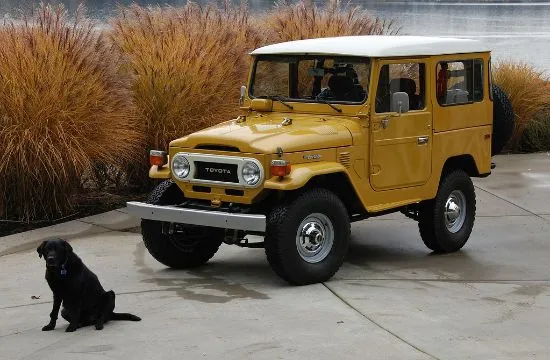
Toyota Land Cruiser Classic
- Les J40 Toyota Land Cruisers étaient équipés de pneus 205 - 16. Le pneu que nous recommandons dans cette taille est le 205 R 16 Michelin X M+S.
- La chambre à air recommandée pour ces pneus est la chambre à air renforcée Michelin 16F Offset Valve.
- La pression des pneus standard du J40 Land Cruiser est de 24 Psi à l'avant et de 34 Psi à l'arrière.
- La pression des pneus à pleine charge du J40 Land Cruiser est de 28 Psi à l'avant et de 40 Psi à l'arrière.
Recommend Tyres for Pneus Toyota Land Cruiser
Recommend Inner Tubes for Pneus Toyota Land Cruiser
History Toyota Land Cruiser
The Toyota Land Cruiser started production in 1950 when the United States tasked Toyota with creating 100 vehicles with the then-new Willys specifications. Toyota's new prototype, the Jeep BJ was produced the following year, it was a larger and more powerful 4x4 than the Willys Jeep, with the BJ having a 3.4L engine and much more equipment space than the 2.2L Willys M38 that was in service at the time. Following a test overseen by the Japanese National Police Agency, the NPA witnessed the Jeep BJ ascend to the sixth stage of Mount Fuji, convincing the NPA to order 289 of them as patrol cars.
In 1953 the Toyota Jeep BJ began standard production at the Toyota plant in Toyota City's Honsya Plant and the assembly and the bodywork were done at what is now known as Araco Co Ltd, a subsidiary of Toyota. The models here also included fire engine versions on cowl chassis. The following year, the technical director, Hanji Umehara dubbed the series of 4x4: Land Cruisers, taken from the British Land Rover to have a title for the models that "would not sound less dignified than those of our competitors". The Studebaker Land Cruiser had ceased production in the same year, allowing for the use of the name.
In 1955 the Land Cruiser gained a reworking, adding more stylish bodywork and new longer four-plate leaf springs. This was in order to create more interest in the 4x4 for civilians to open the market up more as well as to aid exportation. A four-door estate model was developed two years later in the series, also starting exportation to Australia, becoming the first Japanese vehicle to be exported regularly into the country. The Land Cruiser was also the first Car to be built outside of Japan, with a factory in Sao Bernardo, Brazil producing Land Cruisers, known more as the Bandeirante there, which is Portuguese for "Flag Carrier".
20 Series Land Cruisers were upgraded to the beloved 40 series in 1960, benefitting greatly from the new steel pressing machinery, also adopting a larger 3.9L engine as standard. The success of the model was booming fairly soon after launch, with a longer wheelbase, pickup, and cab-chassis model being added to the lineup in 1963, and in 1965, the J40 Land Cruiser was the best selling Toyota in the states and 50,000 units had been sold worldwide, with that record being doubled only 3 years later.
The Land Cruiser's success skyrocketed, with 100k being sold in 1968, 200k in 1972 and 300k in 1973. A smaller 3.0L diesel engine was offered in 1974, allowing it to be in a cheaper tax bracket, something that was essential to boosting Japanese sales. The next year a 4.2L engine model replaced the 3.9L petrol engine that was in use at the time. More upgrades were introduced over the years, including front disc brakes for the petrol engine models in 1975 and 1976, and diesel engine models received them in 1981. A square bezel around the headlights, power steering and air conditioning was introduced in 1979.
The last Fj40s were imported into America as 1983 models between 1982 and 1983 in a limited amount of around 300, making these models a particular rarity and a collector's special. In 1984 the North American exports were restricted to Canada which was left with the BJ42 model. This was the last year of production for nearly all of the J40 Land Cruisers, although the Bandeirante would prove to still be incredibly popular in Brazil and would be sold through Toyota do Brasil Ltda until 2001 with very few changes to the model, with those being a different grille, Mercedes-Benz OM-series diesel engines were used until 1994 when they were swapped for the B-series Toyota diesel engine, and the twin rear doors were swapped for a single rear door.